2 Foundations
theoretical physics, foundations of physics, momentum conservation, canonical momentum, special relativity, stationary gravity, gravitoelectromagnetism, quantum mechanics, FLRW cosmology
2.1 Core Momentum Terms and Directional Notation
This section introduces M1’s three core momentum terms and fixes the directional notation built from them. It serves as a compact reference for what follows; the next section develops the physical configuration these symbols describe.
2.1.1 Fermic momentum
Fermic momentum, written \(p_f\), is the nonnegative intrinsic momentum scale associated with stable internal cycling. At the inertial baseline,
\[ p_f=m_0c, \]
where \(m_0\) labels the particle’s rest-state mass and \(c\) is the invariant local propagation scale. M1 reads the corresponding mass content as momentum locked into the internal cycle associated with the particle’s identity.
2.1.2 Bosic momentum
Bosic momentum, written \(p\), is the nonnegative momentum quantity through which the particle’s internal cycle carries translational expression. Its organization includes both a spherical contribution and an asymmetry with a net direction.
The quantity \(p\) remains the bosic momentum throughout M1. Its vector and component forms describe its directional asymmetry; they do not replace it as the foundational quantity.
2.1.3 Core momentum
Core momentum, written \(M\), is the nonnegative scalar measure of the particle’s total momentum content. In the inertial baseline,
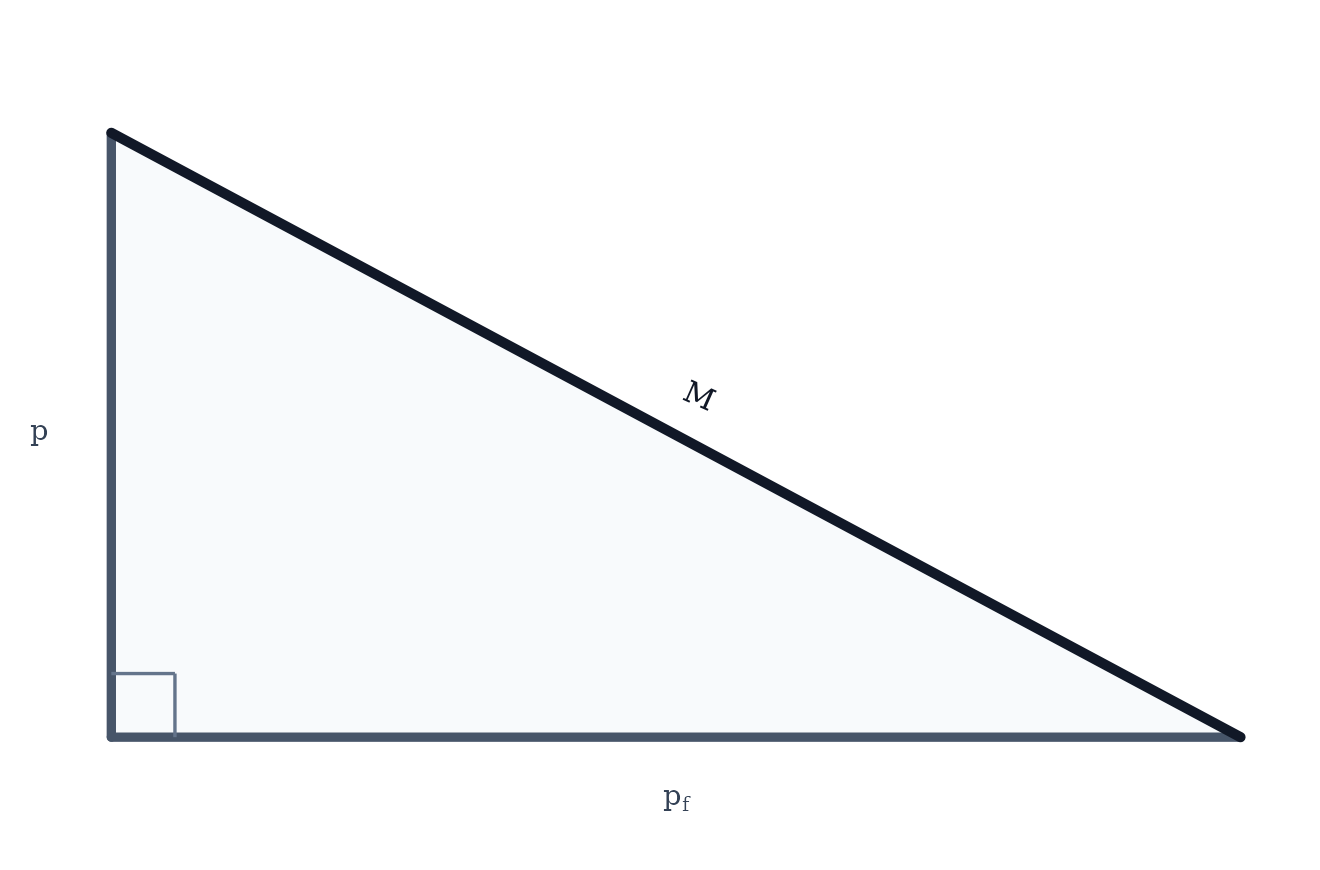
\[ M=\sqrt{p_f^2+p^2}. \]
This is the inertial composition rule for fermic and bosic momentum. Its physical meaning is developed in the next section.
2.1.4 Direction and projection
The net direction of the bosic asymmetry is represented by the vector \(\vec p\), whose magnitude is
\[ p=|\vec p|. \]
For an arbitrarily chosen oriented unit direction \(\hat{k}\), the signed component along that direction is
\[ p_k=\vec p\mathbin{\cdot}\hat{k}. \]
2.1.5 Directional shell readings
Along the net asymmetry axis, the two opposed shell readings are
\[ p^\pm=M\pm\tfrac12p. \]
For the chosen \(k\)-axis, the corresponding readings are
\[ p_k^\pm=M\pm\tfrac12p_k. \]
A direction perpendicular to the net asymmetry has the reading
\[ p^\perp=M. \]
Superscripts \(+\) and \(-\) label opposed positive readings, not arithmetic signs. The quantities \(p_f\), \(p\), \(M\), \(p^\pm\), \(p_k^\pm\), and \(p^\perp\) are nonnegative scalars; \(\vec p\) is a vector, and \(p_k\) is its signed component along \(\hat{k}\). When several particles appear, a particle label is appended as a second subscript: \(M_i\), \(p_{k,i}\), and \(p_{k,i}^\pm\) denote the quantities belonging to particle \(i\). The label is omitted when only one particle is under discussion.
2.1.6 Terminology note
The terms fermic and bosic name momentum roles in M1. Fermionic and bosonic are reserved for structure, geometry, winding, chirality, or state labels. No one-to-one identification between these momentum roles and a later particle classification is assumed here.
2.2 The Momentum Configuration
A particle can translate only because it already has an organized internal momentum structure. M1 begins with that structure and distinguishes two perpendicular geometrical aspects within it: fermionic structure, which carries the particle’s intrinsic organization, and bosonic geometry, on which translational momentum is expressed. Fermic and bosic momentum name the corresponding momentum roles.
2.2.1 Fermionic structure and fermic momentum
A stable particle contains a closed fermionic momentum cycle. This is the persistent structure through which the particle retains its identity while its state of motion changes. Fermic momentum, written \(p_f\), is the momentum locked into that cycle. It supplies the particle’s intrinsic symmetric momentum scale,
\[ p_f=m_0c. \]
The relation ties fermic momentum directly to rest mass: \(m_0\) is the mass reading of momentum confined in the fermionic cycle. Other intrinsic properties, including charge, belong to the organization of that structure rather than to translational motion. Charge is not determined by the magnitude of \(p_f\); it characterizes how the fermionic structure is organized. The detailed geometrical account of those identity properties lies beyond the present foundation.
With no translation, the fermic cycle has no preferred external direction. Its momentum organization is symmetric, and the particle’s core momentum is entirely fermic.
2.2.2 Perpendicular bosonic geometry
In flat space, the fermionic structure supports a bosonic geometry perpendicular to the fermionic cycle. Bosic momentum \(p\) resides on this geometry. The word perpendicular describes the internal geometrical relation between the two momentum roles; it does not place \(p_f\) along one ordinary spatial axis and \(p\) along another.
The fermionic and bosonic aspects are therefore not separate particles or detachable layers. They are perpendicular aspects of one internal particle cycle. The fermionic aspect carries the locked intrinsic scale. The bosonic aspect provides the geometry on which momentum can acquire translational expression. Together these aspects form the spherical internal particle cycle referred to throughout this chapter.
The whole configuration is measured by its core momentum \(M\). In the flat inertial baseline, M1 takes the total core momentum to follow the composition rule
\[ M=\sqrt{p_f^2+p^2}. \]
The perpendicular geometry gives this rule its momentum-triangle interpretation. Fermic momentum and bosic momentum form perpendicular contributions to one momentum configuration and together determine its total core momentum.
2.2.3 Swelling, asymmetry, and translation
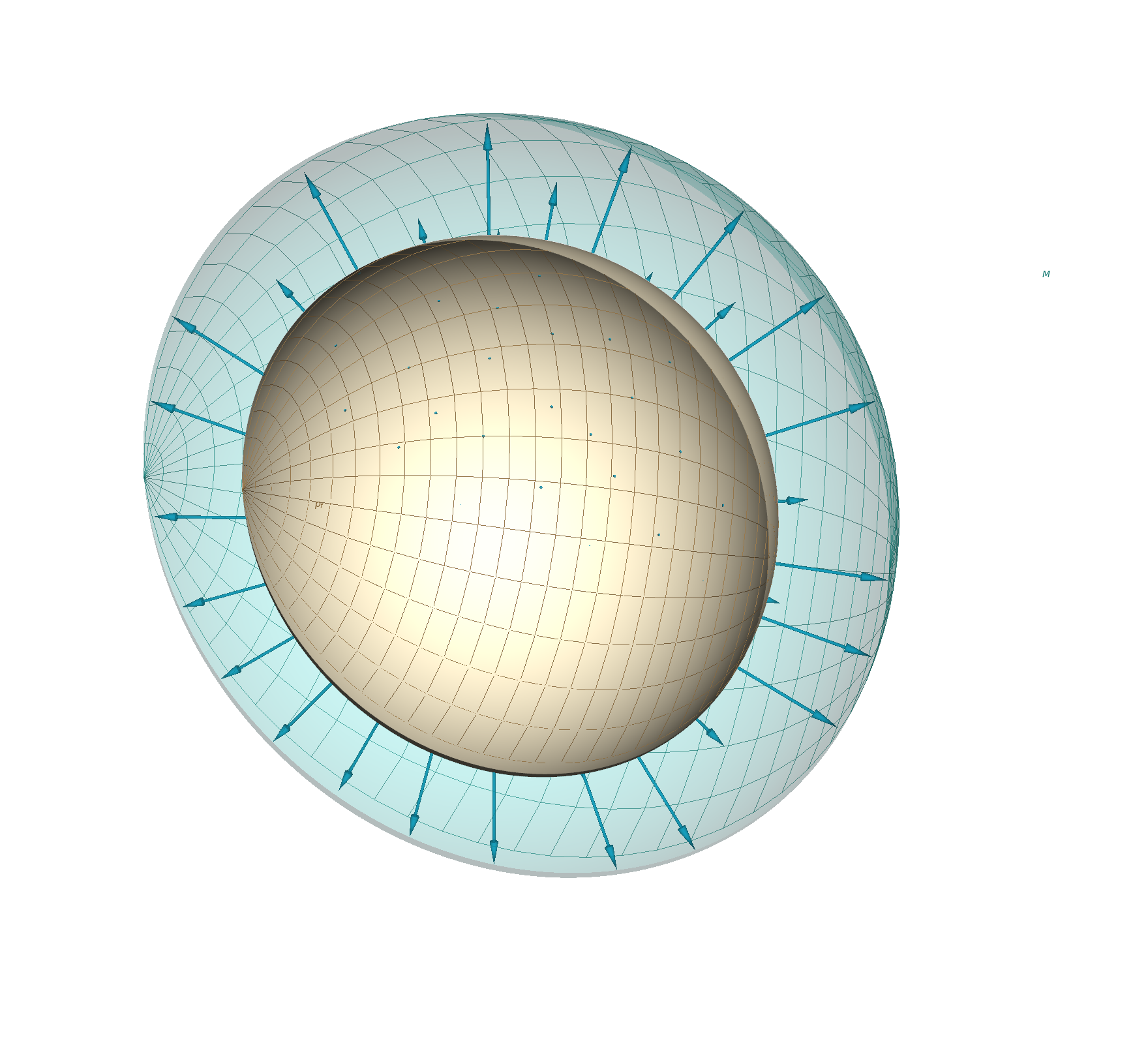
When a particle gains bosic momentum, the whole momentum configuration swells from the fermic scale \(p_f\) to the core scale \(M\). The swelling is the spherical contribution of \(p\) to the combined cycle. It does not yet select a direction: a larger symmetric shell alone would contain no information about which way the particle translates.
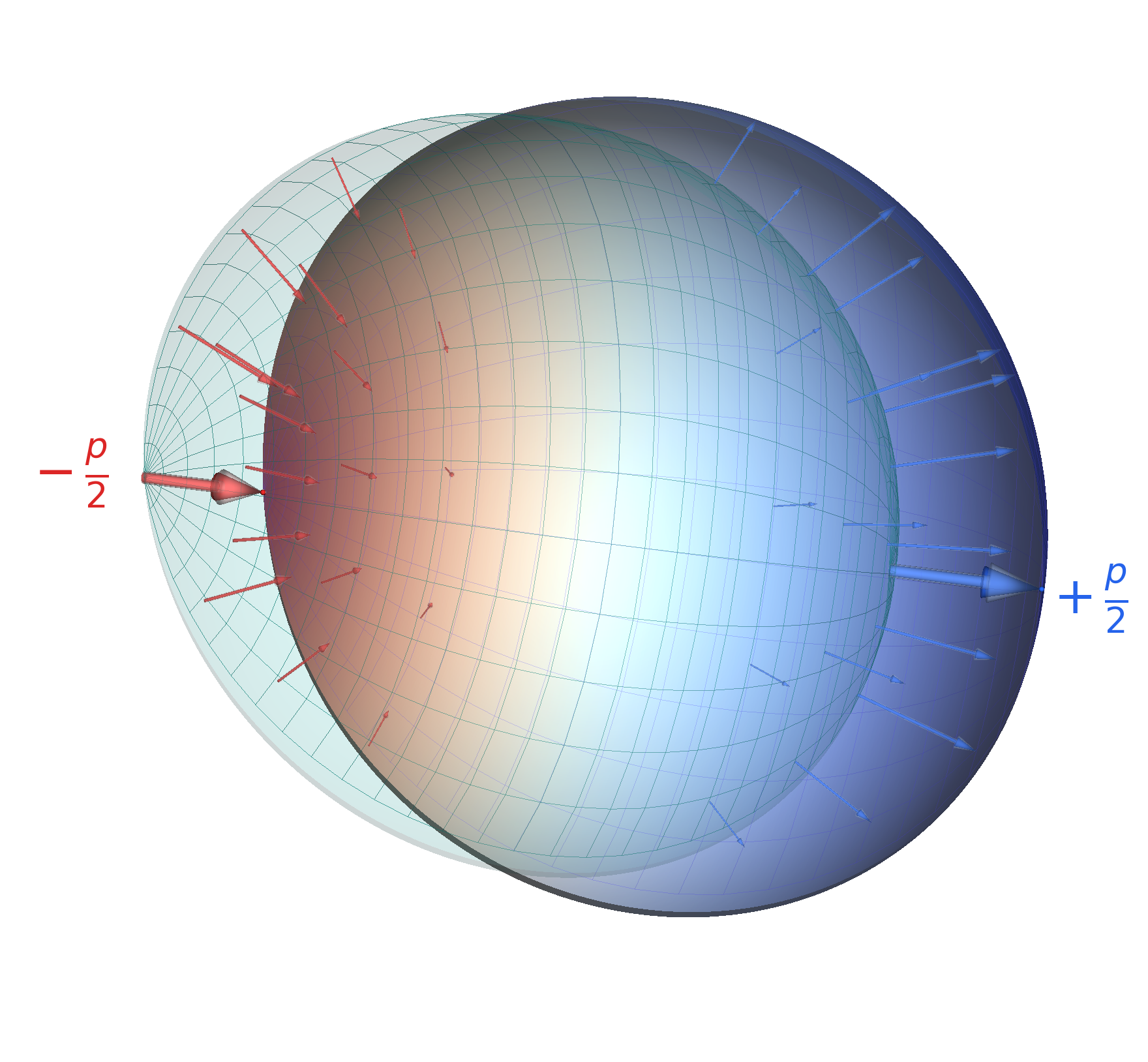
Translation appears because the bosonic structure also carries an asymmetry. Its organization over the spherical cycle is no longer directionally balanced. The shell represents that asymmetry by extending one side relative to \(M\) while contracting the opposite side, producing a net direction. Bosic momentum yields translation through this asymmetry. It is therefore neither an external straight-line component nor a quantity detached from the particle’s internal cycle: its spherical contribution swells the configuration, and its directional imbalance gives that momentum translational expression.
The swelling and asymmetry belong to one changed momentum configuration. They are not successive physical mechanisms. Figure 2.2 separates them only so that each can be seen. Panel (a) compares the symmetric fermic scale \(p_f\) with the swollen core scale \(M\). Panel (b) keeps the spherical core shell \(M\) visible as a reference while encoding the bosic asymmetry over the same structure. Along the net asymmetry direction, one side is displaced outward from \(M\) by \(p/2\), while the opposite side is displaced inward by \(p/2\), giving the complete readings \(M+p/2\) and \(M-p/2\). The deformation represents their organization, not a measured spatial distribution of momentum density. The local arrows describe the deformation across the spherical cycle; they do not represent momentum leaving the particle or flowing along external straight lines.
The limiting configurations make the roles clear. When no momentum is expressed as translation,
\[ p=0, \qquad M=p_f. \]
The core momentum is then entirely fermic. At the purely bosic boundary of the inertial composition rule,
\[ p_f=0, \qquad M=p. \]
The full structural realization of this boundary lies beyond the particle construction developed here. When both roles are present, \(p_f>0\) and \(p>0\), and the core momentum measures the complete configuration rather than either contribution alone.
2.2.4 Choosing a direction
Core momentum \(M\) belongs to the configuration as a whole and does not depend on which spatial direction is chosen. The bosic asymmetry has a net direction represented by the vector \(\vec p\), with magnitude
\[ p=|\vec p|. \]
For any chosen oriented unit direction \(\hat{k}\), the signed component along that direction is
\[ p_k=\vec p\mathbin{\cdot}\hat{k}=p\cos\alpha, \]
where \(\alpha\) is the angle from \(\hat{k}\) to \(\vec p\). The component \(p_k\) records the asymmetry relative to \(\hat{k}\); it does not mean that bosic momentum exists only along a line through the particle. Reversing the orientation from \(\hat{k}\) to \(-\hat{k}\) leaves \(M\) unchanged and reverses the sign of \(p_k\).
Along the net asymmetry axis, the two opposed shell readings are
\[ p^\pm=M\pm\tfrac12p. \]
For the chosen \(k\)-axis, the corresponding readings are
\[ p_k^\pm=M\pm\tfrac12p_k. \]
Figure 2.3 connects the ordinary vector projection to these readings on the directional shell.
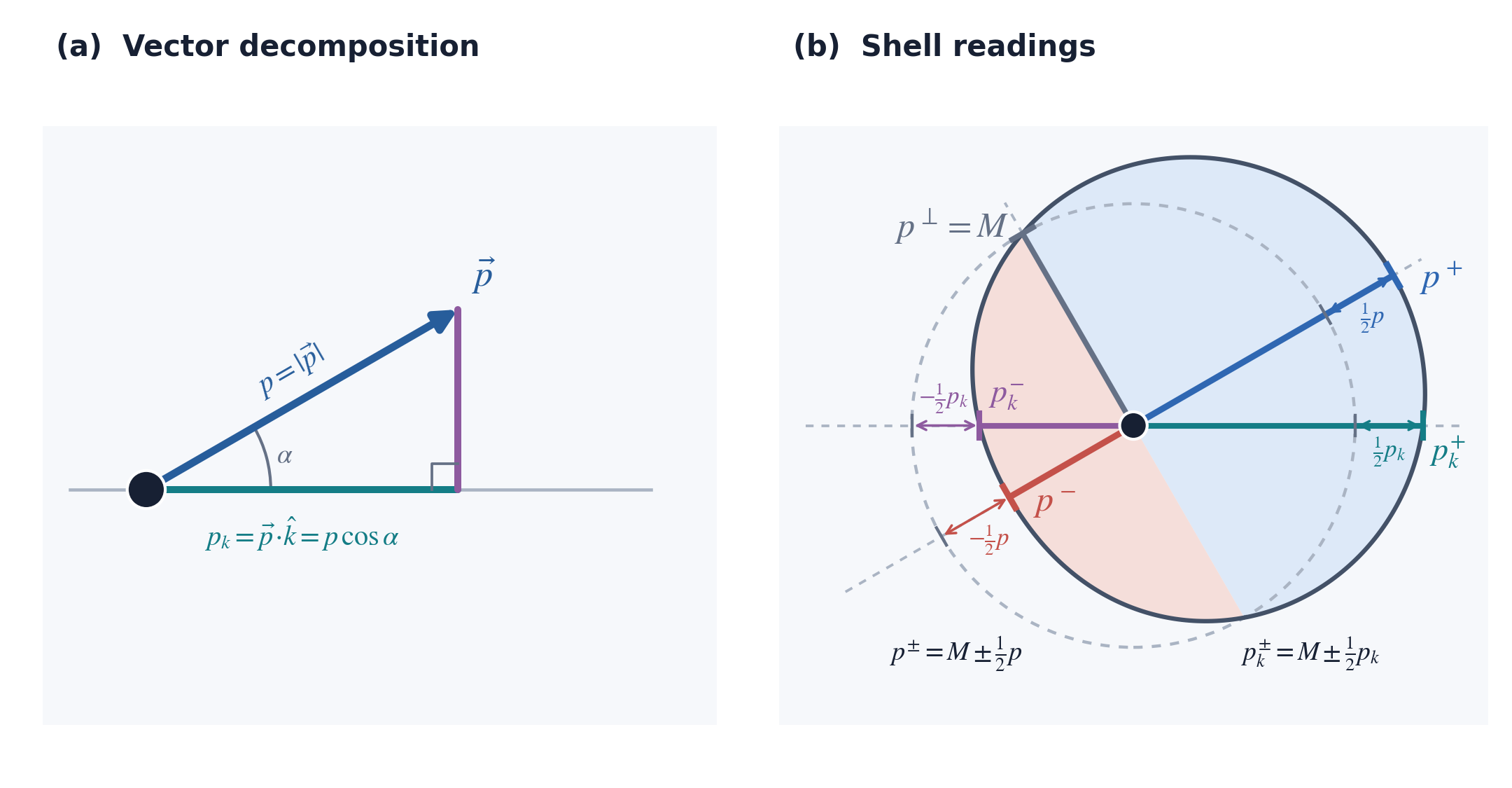
Superscripts \(+\) and \(-\) label the two opposed shell readings; they are not arithmetic signs. The quantities \(p^\pm\), \(p_k^\pm\), \(p_f\), \(p\), and \(M\) all denote nonnegative scalar momentum quantities. By contrast, \(\vec p\) denotes the momentum vector and \(p_k\) its signed component along \(\hat{k}\).
\[ p_k^+=p_k^-=p^\perp=M. \]
Replacing \(\hat{k}\) by \(-\hat{k}\) changes \(p_k\) to \(-p_k\) and exchanges the two readings. The pair \((p_k^+,p_k^-)\) therefore preserves both kinds of directional information: its common center records the positive core momentum, while its asymmetry records the signed component.
Positivity follows directly from the inertial composition rule. Since
\[ |p_k|\le p\le M, \]
the smaller of the two readings satisfies
\[ \min\!\left(p_k^+,p_k^-\right) =M-\tfrac12|p_k| \ge\tfrac12M>0 \]
for every nonempty particle configuration.
The momentum configuration has now supplied the positive directional readings that M1 conserves. The next section states that conservation principle.
2.3 Additive Directional Momentum Conservation (ADMC)
The momentum configuration developed above supplies two opposed positive shell readings, \(p_k^+\) and \(p_k^-\), for every oriented unit direction \(\hat{k}\). M1 places conservation of momentum at the core through the following definition:
For any isolated system and any chosen direction \(\hat{k}\), momentum is conserved directionally as a sum of positive quantities.
We call this principle Additive Directional Momentum Conservation, or ADMC for short. Directional means that the conservation statement is made relative to an arbitrarily chosen direction. Additive means that the conserved quantity contains one positive contribution from every particle in the system.
The conservation rule can be written as:
\[ \sum_i p_{k,i}^+ = \text{constant} \]
for any direction \(\hat{k}\). Using the algebraic form established in the preceding section, the same statement is
\[ \sum_i\left(M_i+\tfrac12p_{k,i}\right) = \text{constant}. \]
The first expression keeps the positive shell reading explicit. The second exposes the core momentum and signed directional component contained within it. ADMC applies equally to the reversed orientation \(-\hat{k}\), for which each contribution is \(p_k^-=M-p_k/2\).
Within the regular additive and symmetry-compatible axis-wise class, Derivation 2.3A shows that canonical normalization uniquely fixes this realized form.
The next section compares these opposite-orientation conservation statements. Their invertible relation recovers total \(M\) and signed \(p_k\), and three independent directional components establish correspondence with special-relativistic four-momentum.
2.4 ADMC Mapping and Inertial Correspondence
The directional shell readings introduced above preserve the complete inertial information carried by \(M\) and signed \(p_k\). The relation is linear and exactly invertible. Applied along three independent directions, it connects the M1 formulation directly to special-relativistic four-momentum.
2.4.1 Opposite-orientation map
For any oriented unit direction \(\hat{k}\),
\[ p_k^+=M+\tfrac12p_k. \]
Reversing the orientation changes \(p_k\) to \(-p_k\) while leaving \(M\) unchanged:
\[ p_k^-=M-\tfrac12p_k. \]
The two readings form the linear map
\[ \begin{pmatrix} p_k^+\\ p_k^- \end{pmatrix} = \begin{pmatrix} 1 & \tfrac12\\ 1 & -\tfrac12 \end{pmatrix} \begin{pmatrix} M\\ p_k \end{pmatrix}. \]
Its inverse is
\[ \begin{pmatrix} M\\ p_k \end{pmatrix} = \begin{pmatrix} \tfrac12 & \tfrac12\\ 1 & -1 \end{pmatrix} \begin{pmatrix} p_k^+\\ p_k^- \end{pmatrix}, \]
or equivalently,
\[ M=\tfrac12\left(p_k^++p_k^-\right), \qquad p_k=p_k^+-p_k^-. \]
The average recovers the positive core momentum. The difference recovers the signed component. The opposite-orientation readings and the pair \((M,p_k)\) are therefore two exactly equivalent representations of the same directional kinematic content.
2.4.2 Conservation consequences
For an isolated system, define the two system readings
\[ \mathcal P_k^\pm = \sum_i p_{k,i}^\pm. \]
ADMC conserves \(\mathcal P_k^+\) for every oriented unit direction \(\hat{k}\) and therefore conserves \(\mathcal P_k^-\) for the reversed orientation \(-\hat{k}\). Applying the inverse map to the two system readings gives
\[ \sum_i M_i = \tfrac12\left( \mathcal P_k^+ + \mathcal P_k^- \right), \]
and
\[ \sum_i p_{k,i} = \mathcal P_k^+ - \mathcal P_k^-. \]
Thus ADMC implies conservation of total \(M\) and total signed momentum along \(k\). Applied along three independent spatial directions, it recovers conservation of total three-momentum together with total \(M\). Conversely, conservation of total \(M\) and the signed components preserves the positive shell readings. At the inertial level, the two conservation formulations are equivalent.
2.4.3 Four-component form
Choose a Cartesian basis with oriented unit directions \(\hat{x}\), \(\hat{y}\), and \(\hat{z}\). The M1 quantities can be assembled into the four-component package
\[ P_+ = \begin{pmatrix} M\\ p_x^+\\ p_y^+\\ p_z^+ \end{pmatrix}. \]
The corresponding signed package is
\[ P_M = \begin{pmatrix} M\\ p_x\\ p_y\\ p_z \end{pmatrix}. \]
They are related by the invertible transformation
\[ P_+=TP_M, \qquad T= \begin{pmatrix} 1 & 0 & 0 & 0\\ 1 & \tfrac12 & 0 & 0\\ 1 & 0 & \tfrac12 & 0\\ 1 & 0 & 0 & \tfrac12 \end{pmatrix}, \]
with
\[ P_M=T^{-1}P_+, \qquad T^{-1}= \begin{pmatrix} 1 & 0 & 0 & 0\\ -2 & 2 & 0 & 0\\ -2 & 0 & 2 & 0\\ -2 & 0 & 0 & 2 \end{pmatrix}. \]
In component form,
\[ p_x=2\left(p_x^+-M\right), \qquad p_y=2\left(p_y^+-M\right), \qquad p_z=2\left(p_z^+-M\right). \]
The four entries of \(P_+\) are a coordinate package for one momentum configuration, not four contributions to a single directional ADMC sum. Exact invertibility means that \(P_+\) and \(P_M\) contain the same four degrees of inertial kinematic information.
2.4.4 Correspondence with special relativity
Standard relativistic energy is introduced through
\[ E=cM. \]
The signed package then becomes
\[ P_M = \begin{pmatrix} E/c\\ p_x\\ p_y\\ p_z \end{pmatrix} =P^\mu, \]
which is the standard special-relativistic four-momentum in a Cartesian inertial frame. The full correspondence is therefore
\[ P_+=TP^\mu, \qquad P^\mu=T^{-1}P_+. \]
The M1 positive-reading package and special-relativistic four-momentum are related by an exact change of representation. The transformation does not discard a sign or introduce an additional degree of freedom; it reorganizes the same inertial momentum content.
The invariant relation agrees as well. M1’s inertial composition rule gives
\[ M^2=p_f^2+p^2, \]
and \(p_f=m_0c\). With metric signature \((+,-,-,-)\),
\[ P^\mu P_\mu =M^2-p^2 =p_f^2 =m_0^2c^2. \]
Equivalently,
\[ E^2=m_0^2c^4+p^2c^2, \]
the familiar special-relativistic energy-momentum relation.
The correspondence is exact at the inertial level. Opposed positive shell readings recover \(M\) and each signed component \(p_k\); three independent components assemble into four-momentum; and the M1 composition rule reproduces the special-relativistic invariant. M1 differs in its foundational ordering: it begins with positive momentum contributions in oriented directions and reaches the familiar four-component formulation through the invertible map.
2.5 Space and Momentum: Stage and Actor
Before turning to clocks and dilation, we need one further stance on space and momentum.
2.5.1 Space as the stage
In M1, space is the stage on which physical systems exist, persist, and change. This does not make it empty scenery. A stage has structure: it determines which relations are available, which configurations can be stable, and what counts as possible motion for a physical system.
If the stage is different, the same momentum content need not support the same trajectories, equilibria, or local kinematic behavior. In the inertial baseline, this stage is treated as given. Later chapters will ask how momentum changes the local stage. Here the needed point is simpler: space conditions the available kinematic relations.
2.5.2 Momentum as the actor
Momentum is the actor of change. Translational motion is momentum expression. Mass is read through locked fermic momentum. Interaction is described through transfer, redistribution, or reorganization of momentum content.
This is the force of the momentum-first claim. What changes in a physical system changes through momentum expressed within spatial relations, not because time acts as an independent driver.
Momentum does not have to be carried by a particle. A particle is one stable organization of momentum, but momentum can also be held in the physical structure of space itself. Space remains the stage, but it need not be passive: its structured state can, in certain situations, carry momentum and participate in its transfer.
2.5.3 Space-mediated momentum coupling - SMC
The stage and the actor are not separate worlds. Momentum is always expressed in space, and space matters because it conditions that expression.
Physical systems also do not exchange momentum across nothing. In M1, every force is understood as a mode of space-mediated momentum coupling: momentum content in one system becomes dynamically relevant to momentum content elsewhere through spatial relation.
This principle is deliberately general. It does not say that electromagnetism, gravity, the strong interaction, and the weak interaction are mechanically identical. They are not. It says that beneath their different mechanisms is a shared form: interaction means that momentum is communicated, constrained, redistributed, or reorganized through space.
The detailed mechanisms differ. For now, the foundation is only this: forces are not external additions to momentum-first physics. They are the ways momentum becomes coupled through space.
2.5.4 Toward clocks and dilation
This distinction now gives us the right starting point for time.
A clock is not driven by time as an independent medium. A clock is a physical system whose momentum content undergoes regular, repeatable change. Its rate depends on how that momentum is organized, coupled, and expressed within the spatial conditions available to it.
If clock rates differ, the first place to look is therefore not a changing time-substance, but a difference in the physical conditions under which the clock’s momentum content can complete its cycle. The next section turns to time and dilation from that standpoint.
2.6 Time, Clocks, and the Interpretation of Dilation
The stage-and-actor distinction changes how M1 speaks about time. Space supplies the relational setting. Momentum carries the changing physical content. Time is not a third actor alongside them. It is the measure abstracted from physical change.
This reverses the usual explanatory order. M1 does not begin with time as an arena and then ask how matter moves through it. It begins with physical systems whose momentum content is organized and expressed in structured ways, then asks how clocks, durations, and temporal order are read from those changes.
2.6.1 Clocks as physical cycles
A clock is a physical system with a stable repeatable cycle. Its rate is therefore not explained by time itself, but by the structure that lets the system cycle.
In M1, the clean primary clock-carrying sector is fermic. Fermic momentum \(p_f\) is the locked intrinsic scale associated with stable internal cycling, and composite material clocks inherit their timing behavior through stable internal structure built from such cycle-carrying constituents.
Bosic momentum matters differently. It is not the intrinsic clock scale, but directed bosic expression changes how the total momentum content of a system is organized. A moving clock therefore does not merely carry the same internal cycle through an external time variable. Its fermic cycle changes relative to the free-current baseline of the surrounding space as the relation between \(M\) and \(p_f\) changes.
This is the section’s central distinction: clock language belongs first to systems with stable internal cycles. Pure massless or bosic transport can still exhibit redshift, phase, and arrival-rate effects, but those should not be casually identified with internal clock slowing in the same sense.
The general cycle-duration factor is
\[ \boxed{ \frac{M}{p_f}. } \]
It tells how much the duration of a fermic cycle changes from that free-current baseline. The inverse ratio \(p_f/M\) is the clock-rate factor: as \(M/p_f\) increases, each cycle takes longer and the clock runs more slowly.
2.6.2 Inertial time dilation
Inertial time dilation is the simplest place where the distinction becomes quantitative. A moving clock runs slow not because time itself stretches, but because more of the system’s total momentum content is expressed bosically. The ratio \(M/p_f\) increases, so the fermic cycle takes longer.
The familiar relativistic clock relation is \[ \Delta \tau = \Delta t\sqrt{1-\frac{v^2}{c^2}}. \] In M1 variables the same inertial relation is written \[ d\tau = dt\,\frac{p_f}{M}. \] Since the inertial baseline gives \[ M^2 = p_f^2 + p^2, \] and since \(p_f=m_0c\) while \(M\) corresponds to \(E/c=\gamma m_0c\), the ratio \(p_f/M\) is the usual inverse gamma factor, \[ \frac{p_f}{M}=\frac{1}{\gamma}=\sqrt{1-\frac{v^2}{c^2}}. \] The formal result is the standard inertial one. What changes is the reading: the slower clock is a slower physical cycle, caused by the system’s changed momentum organization.
The ratio \(M/p_f\) is not specific to inertial motion. It governs the fermic cycle whenever the relation between bosic and fermic momentum changes. What changes from one setting to another is the physical reason: motion reorganizes the particle’s momentum, gravity changes how that momentum configuration is expressed under the local spatial geometry, and expansion changes its expression as the stage evolves. Each later engine must derive how its particular structure changes \(M/p_f\); the cycle rate then follows from the inverse ratio \(p_f/M\).
2.6.3 Motion and material contraction
Directed motion also changes material equilibrium structure. A rod moving along one direction is not merely observed differently, and space itself is not simply compressed around it. In the M1 reading, directed bosic expression changes the effective conditions under which the system’s internal structure remains stable.
That is the constructive reading of length contraction. The same underlying physical laws are not replaced by new laws for moving matter. Rather, the moving system carries a different directional momentum organization, and its stable configuration is determined under those altered kinematic conditions. A moving rod is shorter along the direction of motion because its equilibrium structure is different in that state.
This has clear precedent in Lorentz-type and later Lorentzian-pedagogy accounts of rods and clocks, where contraction and dilation are treated as consequences of the dynamical laws governing moving matter rather than as primitive geometric postulates (Bell 1987; Brown 2005). M1 adopts the same constructive instinct, but expresses it in momentum-first terms: clock slowing and contraction are read as changes in physical cycling and material equilibrium produced by directed momentum expression.
2.6.4 A true frame
If time is a measure abstracted from physical change, then a frame is not a separate version of reality. It is a way of describing relations among physical systems. Different inertial frames may remain equally usable descriptions, and the inertial equations above do not identify a preferred frame. The mathematics of the overlap regime does not need to care.
The foundational picture is different. M1 describes one physical stage populated by momentum-bearing systems. If those systems have one actual configuration of change, then there is one actual present. Two observers may assign different simultaneity slices, but those slices cannot both be equally fundamental versions of now.
The true-frame claim should be read in that sense. It is not an additional equation derived in this subsection, and it is not a claim that the present formalism already tells us how to locate the frame. It is an interpretive consequence of the momentum/space ontology: frame descriptions are plural, but the underlying physical now is singular.
The next question is how the inertial baseline can be modified in controlled ways. That is the role of kinematic modifiers.
2.7 Kinematic Modifiers
Foundations has described the inertial baseline,
\[ M=\sqrt{p_f^2+p^2}. \]
In that baseline, a particle’s momentum configuration and its motion are related in the familiar inertial way. A structured physical setting can change that relation without replacing the particle’s momentum content or adding a new momentum substance.
M1 calls such an effect a kinematic modifier:
A kinematic modifier is a physical structural effect that changes how a particle’s momentum configuration produces motion.
The term names a job, not a universal equation. A modifier is not assumed to be an extra force, a correction attached to an otherwise complete trajectory, or a multiplier applied to every momentum quantity. Each later engine must identify the relevant physical structure and derive the particular momentum-to-motion relation it produces.
2.7.1 What a modifier changes
A particle can retain its fermic and bosic momentum content while the physical expression of that content changes. The same directed bosic momentum may then produce a different translation rate, or the same bound material system may sustain a different internal motion and equilibrium.
Clocks and rulers can reveal such a change because they are moving physical systems. A clock sustains a repeatable internal cycle. A ruler sustains a bound equilibrium through the motions and interactions of its constituents. They are probes of a kinematic modifier, not separate modifier classes.
The defining test remains motion: what does the particle’s momentum configuration physically produce under the structural condition being considered?
2.7.2 Gravity and expansion
Gravity and expansion both give the concept a concrete role, but they need not realize it through the same mechanism.
In gravity, organized momentum changes the local stage. That structured stage changes the conditions under which particle momentum becomes local cycling and translation. The gravity engine must derive the corresponding local motion, material, and light responses from a reciprocal particle–stage construction.
In homogeneous expansion, the stage state \(\chi\) dresses the bosic slot of the core-momentum operator. The resulting translation-yield law is
\[ \dot x_k = \chi^2c\frac{p_k}{M_\chi}. \]
Here the modifier’s mechanism is explicit: bosic-slot stage dressing changes how directed momentum produces displacement. Calling gravity and expansion kinematic modifiers identifies their shared physical role; it does not claim that their realization laws are identical.
2.7.3 Possible state-space effects
Some future effects may change motion by restricting the joint configurations available to particles rather than by adding a force to an already available trajectory. Exclusion may eventually admit such a reading.
That possibility remains open. Foundations does not yet classify exclusion as an established modifier mechanism, because no current M1 derivation shows how its many-particle state restriction descends from the same kind of structure used in gravity or expansion.
2.7.4 Relation to space-mediated momentum coupling
Space-mediated momentum coupling and kinematic modification answer different questions. SMC asks how momentum-bearing systems become dynamically related through space. A kinematic modifier asks how physical structure changes the motion produced by a particle’s momentum configuration.
A coupling may create or sustain the structure that acts as a modifier. The concepts can therefore meet in one engine, but neither is a subtype of the other.
2.8 What Foundations Establishes
Foundations has given M1 a working inertial grammar: the primitive momentum quantities, the directional shell-reading conservation structure, the exact correspondence back to familiar relativistic variables, and the baseline relation \[ M = \sqrt{p_f^2 + p^2}. \]
That grammar is not the whole theory. It is the language in which the rest of the theory can be built.
2.8.1 The inertial foundation
The opening sections fixed the core terms and assembled them into a physical momentum configuration. Fermic momentum \(p_f\) names the locked intrinsic scale of the particle’s internal cycle. Bosic momentum \(p\) belongs to that same spherical cycle. It has a spherical contribution and carries an asymmetry with a net direction; its signed component along a chosen orientation \(\hat{k}\) is \(p_k\). In flat space the fermic and bosic roles are perpendicular contributions to one configuration, and the core momentum \(M\) measures its complete momentum content.
ADMC then gave that vocabulary its conservation structure. For an oriented unit direction \(\hat{k}\), the particle’s two positive shell readings are
\[ p_k^\pm=M\pm\tfrac12p_k. \]
ADMC conserves
\[ \sum_i p_{k,i}^+ \]
for every chosen orientation. Reversing \(\hat{k}\) exchanges \(p_k^+\) and \(p_k^-\). Their average recovers \(M\), while their difference recovers signed \(p_k\). Along three independent spatial directions, the resulting four quantities are exactly and invertibly related to the familiar special-relativistic four-momentum package.
The point is not that M1 has abandoned standard inertial relativity. The point is that it has reorganized the same successful structure around momentum-first primitives and a foundational shell-reading conservation statement.
2.8.2 Space, time, and physical change
Foundations also fixed the framework’s first interpretive order. Space is the stage. Momentum is the actor of physical change. A particle is one stable organization of momentum, but momentum does not have to be carried by a particle: the physical structure of space can, in certain situations, hold momentum and participate in its transfer. Time is not introduced as a separate substance that drives evolution; it is a measure abstracted from stable physical change.
That stance gives the clock discussion its meaning. A clock is a physical system with a stable cycle. In M1, clock slowing is read as changed physical cycling, not as time itself stretching. In the inertial case, the standard relation is recovered through \[ d\tau = dt\,\frac{p_f}{M}, \] with \(p_f/M\) playing the role of the usual inverse gamma factor. The interpretation is different, but the overlap relation is the familiar one.
The same stance also clarifies the true-frame language. Frame descriptions can be plural and operationally usable, but the underlying physical now is singular in the momentum/space ontology. That is an interpretive commitment of the foundation, not an additional inertial equation.
2.8.3 Departures from the inertial baseline
The final foundational move is to make room for controlled departures from the inertial case. The baseline map remains
\[ M = \sqrt{p_f^2 + p^2}, \]
but it is not assumed to exhaust every physical setting. A structured stage can change how a particle’s momentum configuration produces motion without replacing that momentum content.
M1 calls such a structural effect a kinematic modifier. The term identifies a shared physical role, not a universal multiplier or a single mechanism. Gravity and expansion may both modify the relation between momentum and motion, while deriving that change in different ways. In expansion, bosic-slot stage dressing supplies a specific translation-yield law. In gravity, the local stage structure must supply its own particle, material, and light realization.
Clocks and rulers can reveal a modifier because they are physical systems sustained by internal motion and material equilibrium. They are probes, not separate modifier classes. Possible exclusion physics remains a later question: it may eventually restrict the motions available to a many-particle configuration, but Foundations does not yet treat that possibility as an established modifier mechanism.
Space-mediated momentum coupling gives the interaction side of the picture. It states that momentum-bearing systems become dynamically related through space. Kinematic modifiers give a structural motion side: they identify settings in which physical structure changes what motion a particle’s momentum produces.
This is room for later engines, not a completed engine in Foundations. ADMC remains the conservation grammar. SMC supplies the general coupling principle. Each kinematic modifier must still be given a concrete mechanism and realization law where it is used.
2.8.4 What remains beyond Foundations
Foundations has not built the gravity program, the quantum program, the cosmology program, or the later state-space and composite-structure programs. It has not derived full field dynamics, internal particle geometry, or final observational tests. Those are downstream tasks.
This boundary is intentional. A foundation should make the later theory legible before it tries to make the later theory powerful. The reader now has the primitive quantities, the conservation structure, the inertial correspondence, the stage/actor interpretation, the possibility of momentum held directly by space, the clock and true-frame stance, and the kinematic-modifier concept needed to recognize a structurally changed momentum-to-motion relation.
The next part begins with gravity because gravity is the first major case where organized momentum changes the local stage and thereby changes the conditions under which particle momentum becomes motion.